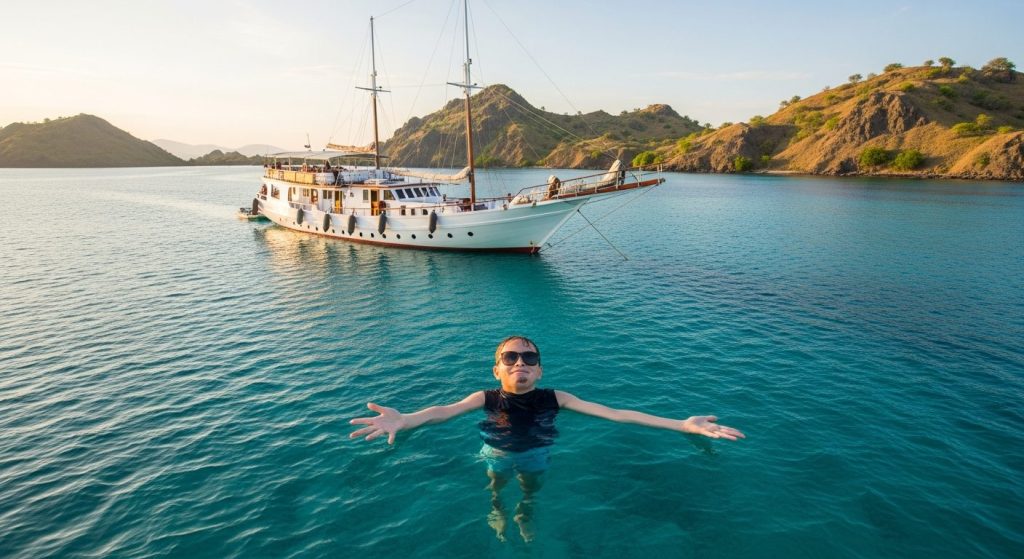
A Komodo diving liveaboard is a private crewed yacht charter that lives at sea for several days so you can dive and snorkel Komodo National Park’s best sites at the right tide, on your own schedule, with a captain, dive guide and chef on board. On a private dive-and-snorkel charter the boat becomes your dive base: you wake near the reef, drop in before the day boats arrive, surface to a hot lunch, and reposition for the afternoon site while non-diving partners snorkel the same waters from the tender.
This page explains what a private dive & snorkel komodo yacht charter actually includes, which sites and seasons matter, and how mixed groups of divers and snorkelers travel together comfortably. Komodo Charter Yacht is a Komodo Luxury specialist: we curate and connect you with vetted crewed-yacht, phinisi and catamaran operators, including dive-equipped vessels with certified guides. We do not own boats, and everything here is information to help you charter well, not safety or certification advice — verify any operator’s dive credentials, insurance and safety procedures directly with that operator before you book. If you proceed with a partner they may pay us a referral fee at no extra cost to you.
What a Komodo diving liveaboard yacht charter includes
A private dive liveaboard differs from a shared group trip in one decisive way: the boat is yours. You set the dive count, the pace, the wake-up times and the balance between diving, snorkeling and surface time on deck. The vessel carries the crew and equipment to run repetitive dives over consecutive days, then moors overnight where the next morning’s site is a short tender ride away.
Inclusions vary by operator and by vessel class, so treat the following as the typical shape of a private dive-and-snorkel charter rather than a fixed guarantee. Confirm the exact list in writing on your quote.
- Crew: captain, deck and hospitality crew, an onboard chef, and one or more dive guides. Guide-to-diver ratios are set by the operator; smaller ratios cost more and suit Komodo’s stronger sites.
- Dive operations: tanks, weights and air fills, a tender for site access, and a guided dive plan tied to the day’s tides. Nitrox, full equipment rental and underwater camera support are often available but frequently priced as extras.
- Snorkel access: masks, fins and snorkels, plus guided snorkel drops at the shallower reef and manta sites so non-divers experience the same water.
- Full board: meals, snacks between dives, water and soft drinks; specialist provisioning and premium wines are usually extra.
- Cabins: private cabins for your party, typically ensuite on the luxury phinisi and motor yachts most often chartered for diving in Komodo.
Certification matters. Several of Komodo’s signature sites involve current and are not entry-level. Operators will ask for your certification level and recent dive experience and may set minimums for the more demanding sites. This is a planning reality, not a formality — be honest about your logged dives so the guide can build a realistic site plan. We describe dive operations in general terms only; the operating vessel sets the final certification, medical and insurance requirements.
Komodo dive & snorkel sites: what to expect by site
Komodo’s reputation rests on nutrient-rich water moving through a maze of channels, which feeds large pelagic life and dense reefs. That same movement is why a liveaboard outperforms a day boat: a private charter can time each site to slack or favourable current rather than a fixed schedule. The table below summarises marquee sites that frequently appear on a Komodo dive itinerary, with an honest note on who each one suits. Conditions change daily; your guide briefs the actual plan on the day.
| Site | Headline marine life | Typical level | Diver / snorkeler suitability |
|---|---|---|---|
| Manta Point (Karang Makassar) | Manta ray cleaning & feeding aggregations | Open Water+, current can build | Excellent for both — mantas often seen by snorkelers in the shallows |
| Batu Bolong | Dense reef fish, sharks, turtles | Advanced — strong current | Divers with current experience; not a snorkel site |
| Castle Rock | Reef sharks, trevally schools, pelagics | Advanced — north Komodo current | Experienced divers; limited snorkel value |
| Crystal Rock | Schooling fish, soft coral, good visibility | Advanced — current-dependent | Experienced divers; surface snorkel only in calm windows |
| Cannibal Rock (south Komodo) | Cold-water macro, frogfish, vivid invertebrates | Advanced — cooler, southern waters | Divers seeking macro; cooler than the north |
| Manta Alley (south) | Mantas, especially in season | Open Water+, conditions vary | Strong for divers and snorkelers when seas allow |
Snorkeling for non-divers on the same boat
One of the practical strengths of a private dive charter is that it accommodates a mixed party. While certified guests dive a current site, snorkelers can be dropped at an adjacent shallow reef or, at the manta cleaning stations, float above the same animals the divers see below. Pink Beach, the reef edges around Komodo and Rinca, and the manta shallows all reward snorkelers. Plan honestly with your guide: a few sites are diver-only because of depth or current, and the crew will route snorkelers to safer, calmer water nearby rather than the same drop point.
Currents, seasons and setting honest expectations
Komodo is a current destination. The channels that concentrate marine life also produce drift, down-currents and changeable conditions, which is precisely why guide experience and tide timing matter more here than at calmer reefs. A private charter’s advantage is flexibility — your guide picks the window — but no operator controls the sea, and wildlife is never guaranteed. Manta encounters are seasonal patterns, not promises.
The broad charter season runs roughly May through September, with shoulder periods around April–May and October–November; these are commercial norms, not formal rules. Sea conditions are generally calmer and crossings easier inside that window. The northwest monsoon months of December to March bring rougher seas and many operators reduce sailings. Water in the cooler southern sites such as Cannibal Rock can be noticeably colder than the north, which affects exposure protection and who enjoys them.
For wildlife, treat seasonality as planning data rather than a guarantee. Mantas are present across much of the year with seasonal peaks; whale-shark sightings are rarer and opportunistic. A bespoke liveaboard itinerary can be sequenced to favour the months and sites with the best historical odds, but the honest framing is always the same: you are buying access and good timing, not a sighting.
Private dive yacht vs shared liveaboard vs day dive boat
There are three common ways to dive Komodo, and the right one depends on your group, budget and tolerance for sharing a schedule. The comparison below is about trade-offs, not a verdict.
- Private dive & snorkel yacht charter
- The whole boat is yours. You control dive count, wake-up times, the diver/snorkeler balance and the route. Best for couples, families and groups who want privacy and a tailored pace. Highest cost per group, strongest fit for mixed-ability parties. Pricing is by quote.
- Shared group liveaboard
- You join other guests on a fixed multi-day dive schedule. Lower cost per person and good for solo divers or those happy with a set programme, but you share the deck, the dive times and the social space, and the itinerary is the operator’s, not yours.
- Day dive boat from Labuan Bajo
- Out-and-back day trips with no overnight. The cheapest entry point and fine for a taster, but you miss dawn and dusk dives, the early-morning manta windows before crowds, and the remote southern and northern sites that a multi-day boat reaches. Long daily transits eat into water time.
If you are weighing a private liveaboard against day diving, the deciding factor is usually access: only an overnight boat reaches the early manta windows and the harder-to-get sites comfortably. If you would like help matching a vessel and dive plan to your group, you can request a private Komodo yacht charter quote and we will route your brief to vetted dive-equipped operators; a quick message over WhatsApp is often the fastest way to start.
How to charter a private dive & snorkel yacht in Komodo
- Send your brief. Tell us your dates, group size, the mix of divers and snorkelers, and your target sites or wildlife (mantas, sharks, macro).
- Certification & experience check. The operator confirms certification levels and recent dive experience so the site plan is realistic and safe for your party.
- Vessel & guide matching. We connect you with vetted dive-equipped phinisi, motor yachts or catamarans with certified guides and a guide ratio that fits Komodo’s conditions.
- Itinerary & site plan. The operator drafts a tide-aware route across your chosen sites, with snorkel alternatives for non-divers at each stop.
- Quote & confirm. You receive a written, by-quote proposal listing exactly what is included and excluded. You book directly with the operator; deposit and terms are theirs to set.
What drives the cost of a Komodo dive charter
Dive charters are priced by quote, not a fixed rate, and figures move with the boat, the season and the dive operation you want. Indicative cost drivers — confirm specifics on quote, last verified June 2026 — include:
- Vessel class and cabins: a traditional phinisi, a stabilised motor yacht and a sailing catamaran sit at different price points; more cabins and higher specification raise the rate.
- Trip length: more nights mean more dives, more remote sites reached and a higher total, but often better value per dive.
- Dive operation: guide ratio, number of dives per day, nitrox, full equipment rental and camera support are frequently priced as add-ons.
- Season: peak months and calm-sea windows carry higher demand; shoulder months can offer value with fewer boats.
- Park & ranger fees: Komodo National Park entry and related fees are usually excluded and subject to Indonesian government rates at the time of visit; budget for them separately.
For broader market context, global crewed charters on mid-sized yachts commonly start in the tens of thousands of dollars per week and rise sharply for superyachts; Komodo dive charters span a wide range below and within that, depending entirely on the vessel and inclusions. Always treat any number as an indicative range confirmed by a per-yacht quote.
Frequently asked questions
Do I need to be an experienced diver to charter a Komodo dive yacht?
Not necessarily, but it depends on the sites. Several signature Komodo sites involve current and suit experienced divers, while others and the manta shallows are accessible to newer divers and snorkelers. The operator sets certification and experience requirements per site and builds the dive plan around your party, so be honest about your logged dives when you enquire.
Can non-divers come along and still enjoy the trip?
Yes. A private charter is well suited to mixed groups. While divers are below, snorkelers can be guided to adjacent shallow reefs or float above the manta cleaning stations, and everyone shares the surface time, meals and island stops. The crew routes non-divers to calmer water at the more demanding diver-only sites.
When is the best time for manta encounters in Komodo?
Mantas are present across much of the year with seasonal peaks, most reliably during the broad May-to-September window when seas are generally calmer. Sightings are wildlife-dependent and never guaranteed; a bespoke itinerary can be timed to favour the better-odds months and sites, but it cannot promise an encounter.
Are dive equipment, nitrox and insurance included?
Tanks, weights and air fills are typically part of a dive charter, while full equipment rental, nitrox and underwater camera support are often priced as extras. Dive insurance and final safety and medical requirements are set by the operating vessel — verify coverage and certification directly with the operator before booking. We provide information, not safety or insurance advice.
How does the referral arrangement work?
Komodo Charter Yacht is. We curate and connect you with vetted dive-equipped operators, and you book directly with the vessel. If you proceed with a partner they may pay us a referral fee at no extra cost to you. We do not own boats and do not set or guarantee operator prices.
Ready to plan a private dive-and-snorkel voyage around Komodo’s manta sites and reefs? Tell us your dates, group and dive goals and we will match you with a vetted operator: request a private Komodo yacht charter quote, or send a quick message over WhatsApp to start the conversation.