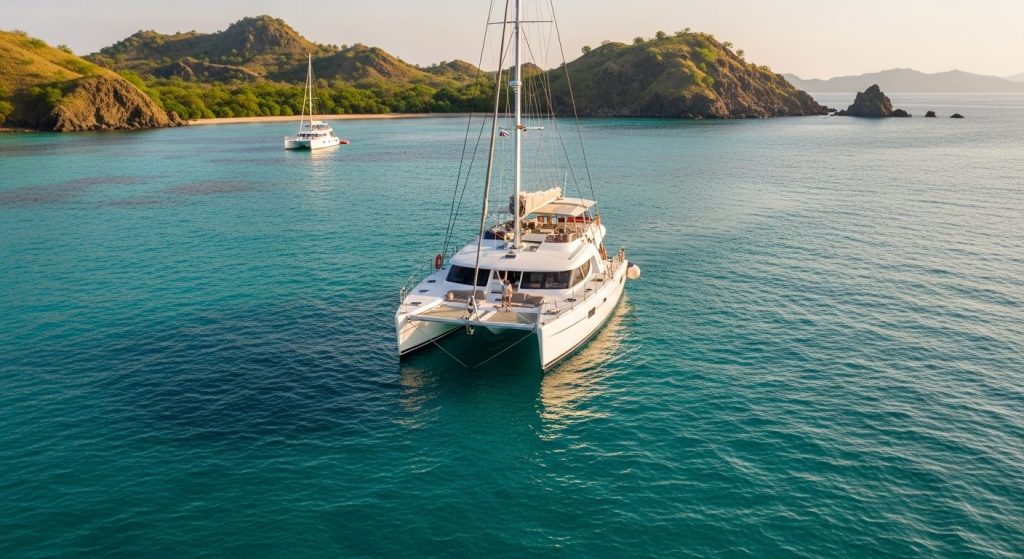
A **Komodo catamaran charter** offers a distinct and often preferred experience for exploring Komodo National Park. These private crewed vessels provide a stable platform and spacious decks, making them a popular choice for families and groups seeking a sailing yacht charter in Komodo. Komodo Charter Yacht serves as a Komodo Luxury concierge, curating and routing enquiries to vetted superyacht, phinisi, catamaran, and motor-yacht operators in Komodo National Park and Labuan Bajo. Our guidance provides transparent cost and itinerary details, with no additional charge to the client.
Why Choose a Catamaran or Sailing Yacht for Your Komodo Charter?
Opting for a catamaran or a traditional sailing yacht for your Komodo island hopping yacht charter provides specific advantages over motor yachts, particularly for guests prioritising a connection with the sea and a gentler pace of exploration.
Stability and Comfort at Sea
Catamarans, by design with their twin hulls, offer superior stability compared to monohull vessels, whether motor yachts or single-hulled sailing yachts. This inherent stability significantly reduces roll, which can be a key factor for guests prone to seasickness or those simply preferring a smoother experience. At anchor, the broad beam of a catamaran provides a level platform, making meal times, sunbathing, or simply relaxing more comfortable. Traditional sailing yachts, while less stable than catamarans, offer a different kind of comfort, often described as a more authentic “sailing” feel, with their deep keels providing a steadying effect, especially when under sail.
Access to Shallow Bays
One practical advantage of many catamarans is their shallower draft compared to monohull sailing yachts or motor yachts of similar length. This characteristic allows them to approach closer to beaches and access more secluded bays and anchorages within Komodo National Park that deeper-draft vessels cannot reach. This proximity means less time spent transferring via tender and more direct access to snorkelling spots or secluded shorelines, enhancing the komodo island sailing charter experience.
The Silent Sailing Experience
The ability to sail without relying on engines offers a unique sensory experience. Gliding across the water with only the sound of the wind and waves fosters a sense of tranquility. This quiet operation reduces fuel consumption, aligning with a more environmentally conscious approach to travel within a protected marine park. For those seeking a reprieve from engine noise and a deeper immersion in the natural environment, a komodo catamaran sailing charter or a traditional sailing yacht offers this.
Catamaran vs. Monohull Sailing Yacht: A Comparison
Understanding the fundamental differences between these two sailing vessel types can inform your choice for a sailing yacht charter Komodo.
- Catamaran (Multi-hull Sailing Yacht)
-
- Layout: Wide beam allows for expansive deck space and typically larger, more private cabins distributed across two hulls. Saloons are often on a single level, creating an open-plan living area.
- Stability: Very stable due to twin hulls. Reduces roll, which can mitigate seasickness.
- Speed: Generally faster than monohull sailing yachts on a beam reach or broad reach; can achieve good average speeds.
- Draft: Shallower draft, enabling access to more secluded coves and closer proximity to shorelines.
- Deck Space: Abundant outdoor lounging areas, trampolines at the bow, and large aft cockpits.
- Manoeuvrability: Excellent manoeuvrability in tight spaces due to engines in each hull.
- Experience: Often perceived as a “floating villa” experience, ideal for socialising and spacious comfort.
- Monohull Sailing Yacht
-
- Layout: Deeper, narrower hull. Cabins are typically arranged fore and aft, often with a more traditional, “boat-like” feel. Saloons are usually below deck.
- Stability: Experiences more heel (tilt) when sailing upwind but provides a steady motion through waves with its deep keel.
- Speed: Can be faster than catamarans when sailing directly into the wind (upwind performance), but generally slower on average across a range of points of sail.
- Draft: Deeper draft due to the keel, potentially limiting access to very shallow anchorages.
- Deck Space: Less overall deck space compared to a catamaran of similar length, with a more concentrated cockpit area.
- Manoeuvrability: Requires more space for turning circles due to single rudder and often single engine.
- Experience: Offers a more traditional, engaging “sailing” feel; often preferred by sailing purists.
Understanding Komodo Sea Conditions and Wind Seasons
The dynamic marine environment of Komodo National Park is influenced by distinct monsoon seasons, which dictate wind patterns, sea conditions, and subsequently, the optimal times and routes for a komodo catamaran sailing charter. Understanding these seasons is key to planning your Komodo sailing adventure.
Dry Season (May-September): Optimal for Sailing
From May through September, Komodo experiences the Southeast (SE) monsoon. This period is characterised by consistent, moderate to strong winds, typically ranging from 15 to 25 knots. These conditions are generally considered optimal for sailing, particularly for those who enjoy the thrill of being under canvas. The winds are reliable for extended periods of sailing without engine assistance.
However, these strong SE winds also generate choppier seas, especially in the southern parts of the park and areas exposed to the Indian Ocean swell, such as around Padar Island and parts of Komodo Island’s southern coast. While catamarans handle chop well due to their stability, guests should anticipate more motion in these exposed areas. Northern anchorages and the calmer waters around Kanawa and Sebayur islands remain relatively protected. Air temperatures during this time are comfortable, ranging from 26°C to 30°C.
Wet Season (November-March): Calmer Waters, Variable Winds
The Northwest (NW) monsoon prevails from November to March. This season brings generally calmer sea conditions, particularly in the southern reaches of the park, as the prevailing winds blow from the north and west, offering some protection from the Indian Ocean swell. Winds are typically lighter and more variable during this period, often ranging from 5 to 15 knots. While still possible to sail, extended periods under sail might require more reliance on engine power, making it a good time for those who prefer calmer cruising.
Rainfall is more frequent during the wet season, usually occurring as short, intense showers rather than prolonged downpours. Visibility for diving and snorkelling can sometimes be affected by runoff, though often remains excellent. Water temperatures remain warm, typically 28°C to 30°C.
Shoulder Seasons (April & October): Often Ideal
The shoulder months of April and October often present a balance of good weather and moderate conditions.
* **April:** Transitioning from the wet to the dry season, April often sees diminishing rainfall and increasing winds, offering a taste of the drier, breezier conditions to come without the full intensity of the SE monsoon.
* **October:** Moving from the dry to the wet season, October typically still enjoys dry weather but with decreasing wind strengths, making for very pleasant, calm cruising conditions, though sailing opportunities may be less consistent than in the peak dry season.
These months can be excellent choices for a luxury catamaran charter Komodo National Park, providing comfortable conditions for both sailing and exploring.
Navigating Currents and Swells
Beyond seasonal winds, Komodo National Park is renowned for its strong tidal currents, especially in passages like Lintah Strait between Rinca and Komodo. These currents are a significant factor for all vessels, regardless of type, and require experienced local captains. Your Komodo catamaran charter private crew will be adept at timing transits and selecting anchorages to ensure safety and comfort. While catamarans offer stability, they are not immune to the effects of strong currents, and careful navigation is paramount. Indian Ocean swells can also penetrate the southern parts of the park, even during the wet season, and should be considered when planning itineraries.
Catamaran and Sailing Yacht Types in Komodo
The Komodo archipelago hosts a range of private crewed sailing vessels, from modern, purpose-built catamarans to classic monohull sailing yachts. Each type offers a distinct experience, catering to different preferences for comfort, space, and sailing authenticity.
Luxury Catamarans: Space and Stability
Luxury catamarans available for charter in Komodo are typically modern, well-appointed vessels ranging from 40 to over 70 feet in length. These are often European-built, from renowned shipyards known for their comfort and design. Their defining characteristic is the expansive space they offer, both indoors and out.
* **Layout:** Multiple cabins, usually 3-6, often with en-suite bathrooms, distributed between the two hulls. A large, bright saloon and galley are typically located on the main deck level, offering panoramic views.
* **Deck Areas:** Large aft cockpits for al-fresco dining, spacious foredecks with trampolines for lounging, and often a flybridge or upper deck area for additional sunbathing or socialising.
* **Amenities:** Equipped with air conditioning, generators, watermakers, and a range of water sports equipment.
Monohull Sailing Yachts: Traditional Appeal
While less common than catamarans for charter in Komodo, traditional monohull sailing yachts also offer private crewed experiences. These vessels typically appeal to guests who appreciate the classic sailing experience, including the sensation of heeling and a deeper connection to the act of sailing.
* **Layout:** Cabins are usually more compact and located below deck, often with shared or smaller en-suite facilities. The saloon is generally a more intimate space below the waterline.
* **Deck Areas:** Deck space is typically more focused around the cockpit, which serves as the primary outdoor social area.
* **Experience:** Offers a more authentic sailing feel, with the vessel leaning into the wind.
Crew Ratios and Service Levels
For both catamaran and sailing yacht charters in Komodo, a dedicated crew is standard. The crew-to-guest ratio on luxury charters typically ranges from 1:2 to 1:3. A standard crew might include:
* **Captain:** Responsible for navigation, safety, and itinerary planning.
* **Chef:** Prepares all meals, often accommodating dietary preferences.
* **Steward/Stewardess:** Provides service, housekeeping, and assists with guest needs.
* **Deckhand/Engineer:** Assists with vessel operations, maintenance, and water sports.
* **Dive Master/Instructor (optional):** If diving is offered, a certified professional will be on board. The service level aims to be discreet and attentive, ensuring guests’ needs are met without intrusion. The local knowledge of the Komodo sailing charter sea conditions and the best anchorages is invaluable for a seamless voyage.
Typical Layouts and Capacities
The design of catamarans and sailing yachts prioritises different aspects, leading to variations in their internal and external layouts. Understanding these can help determine the best fit for your Komodo catamaran charter.
Guest Cabins and Facilities
Catamarans, due to their twin-hull design, generally offer more spacious and private guest cabins compared to monohull sailing yachts of similar length.
* **Catamarans:** Typically feature 3 to 6 cabins, often queen-sized, with en-suite bathrooms. Cabins are usually positioned in the hulls, offering good separation and privacy. The wide beam allows for larger windows or portholes, providing natural light and ventilation. Some luxury models feature a master suite spanning the entire beam of one hull.
* **Monohull Sailing Yachts:** Cabins are generally more compact, often with V-berths or Pullman berths, and may have shared bathroom facilities, or smaller en-suites. The layout is more traditional, following the curve of the single hull.
All luxury vessels will provide high-quality linens, air conditioning, and storage space for personal belongings.
Deck Space and Amenities
The outdoor areas are central to the Komodo island hopping yacht charter experience, allowing guests to immerse themselves in the environment.
* **Catamarans:** Offer expansive deck space. The main deck typically features a large aft cockpit for shaded al-fresco dining and lounging, directly accessible from the saloon. Forward, trampolines provide a relaxed area for sunbathing or watching dolphins. Many also include a flybridge with additional seating, a helm station, and often a wet bar. The stability at anchor makes these spaces highly usable.
* **Monohull Sailing Yachts:** Deck space is more concentrated. The primary outdoor area is the cockpit, usually located aft, providing seating and the helm station. Foredecks are generally smaller and less open, often used for sail handling.
Common amenities across both types of luxury vessels include: * **Dining Areas:** Both indoor and outdoor dining tables. * **Lounging:** Sun pads, comfortable seating, and shaded areas. * **Water Access:** Swim platforms and easy access to the water for swimming and water sports. * **Entertainment:** Sound systems, often with connectivity for personal devices. * **Wi-Fi:** Though connectivity can be intermittent in remote areas of Komodo National Park.
Guest Capacity
The capacity for guests on private crewed catamarans and sailing yachts in Komodo typically ranges from 4 to 12 individuals.
* **Smaller Catamarans (e.g., 40-50 ft):** Often accommodate 4-8 guests in 2-4 cabins.
* **Larger Catamarans (e.g., 50-70+ ft):** Can comfortably host 8-12 guests in 4-6 cabins.
* **Monohull Sailing Yachts:** Generally accommodate fewer guests, often 4-6, due to more compact cabin arrangements.
The ideal capacity depends on the desired level of privacy and the composition of your group. Our advisors can help match your party size with suitable vessels, ensuring comfortable accommodation for everyone on your luxury catamaran charter Komodo National Park.
What’s Included in Your Private Sailing Charter Komodo
Understanding the inclusions and exclusions of a private sailing yacht charter Komodo Labuan Bajo is crucial for managing expectations and budgeting. Our curated charters aim for transparency regarding all costs.
Full Board Culinary Experience
A Komodo catamaran charter private typically operates on a full-board basis. This means:
* **Dedicated Chef:** A professional chef is part of your crew, responsible for preparing all meals onboard.
* **Three Meals Daily:** Breakfast, lunch, and dinner are provided, often with snacks available throughout the day.
* **Customised Menu:** Menus are typically tailored to your dietary preferences, allergies, and requests, discussed prior to your departure. Fresh, local ingredients, including seafood, are prioritised.
* **Non-Alcoholic Beverages:** Water, soft drinks, juices, coffee, and tea are usually included.
Crew and Service
The expertise and service of the crew are integral to the luxury charter experience.
* **Experienced Crew:** The captain, chef, steward(s), and deckhand(s) are included. Their salaries, provisions, and accommodation are covered.
* **Guest Services:** Daily housekeeping, meal service, and assistance with activities are part of the crew’s duties.
* **Local Expertise:** The crew’s knowledge of Komodo sailing charter sea conditions, safe anchorages, and local attractions enhances the itinerary.
Water Sports and Activities
Most Komodo catamaran sailing charters come equipped with a range of water sports equipment for guest enjoyment.
* **Snorkelling Gear:** Masks, snorkels, and fins in various sizes.
* **Kayaks/Paddleboards:** Usually 1-2 units for exploring shallow waters and shorelines.
* **Tender/Dinghy:** For transfers to shore, remote beaches, or water sports activities.
* **Fishing Gear:** Basic trolling or hand-line fishing equipment may be available.
* **Diving (Often Extra):** While some vessels may have a dive compressor and tanks, a dedicated dive master/instructor and specific diving excursions are often an additional cost, requiring pre-arrangement. This ensures specialised equipment and professional guidance.
Fuel and Park Fees
The operational costs of the yacht and access to the park are generally covered.
* **Fuel:** Standard fuel consumption for the agreed itinerary is typically included. Significant deviations or extensive motor use beyond the agreed plan may incur additional charges, though this is rare on a sailing charter.
* **Komodo National Park Fees:** Entrance fees for all guests (domestic and international) and the vessel permit fees are usually included. This covers access to the park’s islands and marine areas.
* **Port & Clearance Fees:** Standard port fees and clearance procedures in Labuan Bajo are generally included.
What is Typically Not Included
To maintain transparency, it is important to note what usually falls outside the standard charter fee:
* **Alcoholic Beverages:** Beer, wine, and spirits are typically not included but can be provisioned at an additional cost based on your preferences.
* **Diving:** As mentioned, dedicated diving trips with a certified instructor, equipment rental (beyond basic snorkelling), and dive site fees are often extra.
* **Specialised Activities:** Massages, guided treks (beyond simple beach walks), or highly specific tours may incur additional costs.
* **Crew Gratuities:** Customary tips for the crew, usually 10-15% of the charter fee, are at the client’s discretion and are not included in the base rate.
* **Flights & Transfers:** Airfare to and from Labuan Bajo (LBJ) and land transfers to and from the port are separate arrangements.
Crafting Your Komodo Island Hopping Yacht Charter Itinerary
A private Komodo island hopping yacht charter allows for a highly customised itinerary, designed around your interests, the prevailing Komodo sailing charter sea conditions, and the rhythm of the tides. The typical duration for an immersive experience is 3 to 7 nights, commencing and concluding in Labuan Bajo.
Iconic Destinations: Padar, Komodo, Rinca
The core of any Komodo itinerary involves visiting the park’s main islands, each offering a distinct experience:
* **Padar Island:** Renowned for its panoramic viewpoint, offering a unique perspective of three crescent-shaped beaches with different sand colours. A hike to the summit is a popular activity, best undertaken early morning for sunrise views before the heat intensifies.
* **Komodo Island:** Home to the largest population of Komodo dragons. Guided treks with park rangers are mandatory and provide an opportunity to observe these ancient reptiles in their natural habitat.
* **Rinca Island:** The second-largest island with a significant dragon population, often considered more accessible for dragon sightings due to a more open savanna landscape around the ranger station.
Beyond the ‘big three,’ your charter can explore numerous smaller islands and bays.
Diving and Snorkelling Hotspots
Komodo National Park is celebrated globally for its vibrant marine biodiversity and offers some of the best diving and snorkelling in the world.
* **Manta Point (Karang Makassar):** A consistent site for encountering majestic manta rays, often seen feeding or at cleaning stations. Snorkelling here is possible, but diving offers a closer perspective.
* **Pink Beach (Pantai Merah):** Famous for its unique pink-hued sand, derived from microscopic red organisms. The coral reefs directly offshore are excellent for snorkelling, with diverse fish and coral species.
* **Batu Bolong:** A small rock pinnacle known for its rich coral gardens and abundant fish life, including reef sharks and turtles. Strong currents here necessitate experienced guides.
* **Kanawa & Sebayur Islands:** Offer calmer waters and beautiful, accessible reefs suitable for all levels of snorkellers and divers.
* **Castle Rock & Crystal Rock:** Advanced dive sites known for strong currents and large pelagic encounters, including sharks and schooling fish.
Customisation and Flexibility
The primary advantage of a private luxury catamaran charter Komodo National Park is the flexibility to tailor the journey to your preferences.
* **Activity Focus:** Whether your priority is extensive diving, leisurely snorkelling, hiking, relaxing on secluded beaches, or a mix of everything, the itinerary can be adjusted.
* **Pace of Travel:** You can choose a fast-paced itinerary to see more, or a relaxed schedule with more time at each location.
* **Weather Adaptability:** The captain will continuously monitor Komodo sailing charter sea conditions and weather forecasts, adjusting the route for optimal comfort and safety. This might mean favouring northern anchorages during strong SE winds or seeking calmer bays if swells are present.
* **Special Requests:** From specific meal preferences to celebrating a special occasion onboard, the crew is there to accommodate your needs.
Our advisors will work with you to design a draft itinerary, then connect you with the vetted operator whose vessel and crew can best bring that vision to life.
Indicative Rates for Komodo Catamaran Charter Private
The cost of a private luxury catamaran charter in Komodo, or a sailing yacht charter Indonesia, varies significantly based on several factors. Our role is to provide transparent guidance and connect you with operators offering competitive rates for the quality of experience delivered.
Factors Influencing Charter Costs
Several key elements determine the daily or weekly rate of a Komodo catamaran charter private:
* **Vessel Size and Type:** Larger, newer, and more luxuriously appointed catamarans or sailing yachts naturally command higher rates. Monohull sailing yachts generally have a different pricing structure than catamarans.
* **Seasonality:** High season (Dry Season: June-September, plus major holidays like Christmas/New Year and Easter) typically sees the highest rates. Shoulder seasons (April, May, October) often offer a balance of good weather and slightly lower pricing. Low season (Wet Season: November-March, excluding holidays) can have the lowest rates.
* **Duration of Charter:** Longer charters often result in a slightly lower daily rate compared to very short charters.
* **Inclusions:** While our listed inclusions are standard, some operators may offer “all-inclusive” packages that incorporate diving, alcoholic beverages, or other special services, which will affect the base rate.
* **Crew Experience and Number:** A highly experienced, larger crew on a top-tier vessel will be reflected in the pricing.
Rate Ranges (last verified June 2026)
As a Komodo Luxury concierge, we do not set prices but provide indicative ranges based on our market observations. These rates are for the vessel and crew, with the standard inclusions discussed previously. Actual pricing will be confirmed upon quotation from our vetted partner operators. * **Mid-Range Catamarans (40-50 ft):** Expect indicative daily rates from **USD 2,000 to USD 4,000** per night. These vessels typically accommodate 4-8 guests.
* **Luxury Catamarans (50-70+ ft):** Indicative daily rates can range from **USD 4,500 to USD 8,000+** per night. These are generally newer, more spacious vessels with higher specifications and service levels, accommodating 8-12 guests.
* **Monohull Sailing Yachts:** For private crewed monohulls, indicative daily rates typically fall between **USD 2,000 to USD 5,000** per night, depending on size and level of luxury. These ranges are for the charter fee itself. Guests should also budget for additional expenses such as alcoholic beverages, diving (if not included), crew gratuities, and personal incidentals. Our advisors provide a detailed breakdown of all potential costs during the planning process.
Komodo Catamaran Charter vs. Motor Yacht: Making Your Choice
When planning a private yacht charter in Komodo National Park, a fundamental decision involves choosing between a komodo catamaran charter and a motor yacht. Each vessel type offers distinct advantages and a different experience. The choice often comes down to priorities regarding speed, stability, comfort, and the nature of the journey.
Performance and Speed
* **Motor Yachts:** Designed for speed and efficient long-distance travel under power. They can cover greater distances more quickly, allowing for a broader reach across the park or more time at specific destinations within a shorter charter period. Their speed makes them less susceptible to the vagaries of wind, offering a more predictable transit time.
* **Catamarans/Sailing Yachts:** While modern catamarans can motor at reasonable speeds (typically 8-12 knots), their primary design is for sailing. Their speed under sail is dependent on wind conditions. A Komodo catamaran sailing charter offers a slower, more deliberate pace, prioritising the journey itself over rapid transit. When winds are light, they will rely on their engines.
Stability and Comfort
* **Catamarans:** As discussed, catamarans excel in stability due to their twin hulls. This significantly reduces rolling motion, both underway and at anchor. For guests sensitive to motion or those seeking maximum comfort and a level platform, a catamaran is often the preferred choice. Their wide beam also translates to expansive deck space and generous interior volumes.
* **Motor Yachts:** Can experience more roll, especially in choppy seas or at anchor, unless equipped with advanced stabilisation systems (e.g., fin stabilisers, gyroscopic stabilisers). When properly stabilised, they can offer very smooth cruising. However, without these, they can be less comfortable in rougher conditions than a catamaran.
* **Monohull Sailing Yachts:** Experience more heel (tilt) when sailing upwind but offer a steady motion through waves with their deep keel. At anchor, they are generally less stable than catamarans.
Environmental Impact
* **Catamarans/Sailing Yachts:** When sailing, these vessels rely on wind power, significantly reducing fuel consumption and carbon emissions. This offers a more environmentally conscious way to explore a protected marine park. Even when motoring, their typically smaller engines can be more fuel-efficient than the powerful engines of larger motor yachts.
* **Motor Yachts:** Are entirely reliant on fossil fuels for propulsion, leading to higher fuel consumption and emissions. While modern engines are increasingly efficient, the environmental footprint is generally larger than a sailing vessel. For guests prioritising eco-friendliness, a sailing yacht charter Indonesia, particularly a catamaran, aligns better with this value.
Overall Experience
* **Catamaran/Sailing Yacht:** Offers a tranquil, immersive experience. The quiet glide under sail, the connection to the elements, and the ability to access shallower anchorages define this type of charter. It’s often chosen by those who appreciate the journey as much as the destination, favouring a relaxed pace and the authentic feel of being on a sailing vessel.
* **Motor Yacht:** Provides a powerful, swift, and often more private experience. Guests can cover more ground, access more remote areas quickly, and often benefit from a wider array of high-speed water toys. The experience is typically one of efficiency and often greater luxury in terms of interior finish and amenities, making it a Komodo charter catamaran vs motor yacht choice for those prioritising speed and refined comfort above all. The best choice depends on your group’s specific desires for your Komodo island hopping yacht charter. Our advisors can discuss these trade-offs in detail to help you select the ideal vessel.